


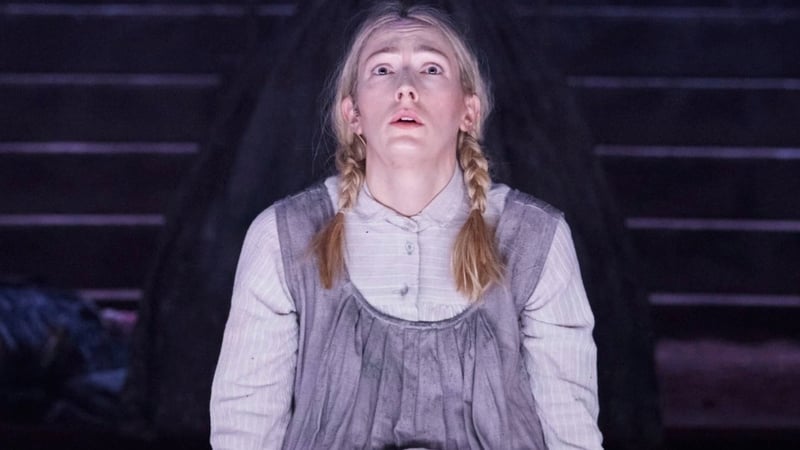

'Two hours is a short time and an eternity: to use two hours of public time is a fine art.' Barbara Bergin’s new play at the Abbey brings theatre director Peter Brook’s words to mind. In Dublin Gothic, Bergin sees these stakes and raises them.
While the play is primarily set in No. 1 O’ Rehilly Parade, a four storey Georgian tenement north of the Liffey, its ambition is vast. Spanning 100 years between the 1880s and 1980s, Dublin Gothic reels in the Dublin years of the Easter Rising, whizzing through post-independence hierocracy, mass emigration, heroin and AIDS epidemics charting the progress of female emancipation all within a three-act play that features 154 characters – both living and dead – portrayed by a cast of 19 actors over a mere three and a half hours.
A commitment to and realisation of such an ambitious project would have been challenging in 1968 when Brook published these words, but even with two intervals, in the current context of diminished attention spans and budgets, it is perhaps a necessary challenge to audiences and a daring punt for the Abbey.
We need your consent to load this rte-player contentWe use rte-player to manage extra content that can set cookies on your device and collect data about your activity. Please review their details and accept them to load the content.Manage Preferences
Listen: The team behind Dublin Gothic talk to RTÉ Arena
In following the fortunes of three families – the Gatelys, the Cumminses and the Meehans - across generations through one house, Dublin Gothic waves from afar to similar undertakings in Tom Stoppard’s Arcadia and its blurring of timeframes and appropriation of cultural figures distantly nods to Caryl Churchill’s Top Girls. No play about Dublin tenement life could exist however, without Sean O’ Casey and the linguistic dexterity and musical vernacular of Bergin’s Dublinese unmistakeably pays homage in such lines as ‘Shut yer coddlebox, ya oul’ hairbater!’ There are reverberations of Bessie Burgess’ bitter word in the figure of nosey neighbour and ‘trumpeter of the unpalatable truth’ Bridie Meehan, who resists fellow tenant Ned Cummins’ organisation of a rent strike on the basis that "I’ll get thrun out over you trying to get ahead in the communism, Ned Cummins".
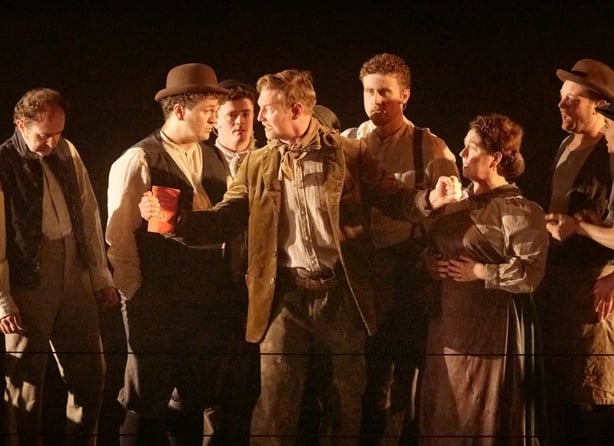
inhabitants of a Georgian tenement north of the Liffey.
Like The Plough and the Stars, the fulcrum upon which Dublin Gothic pivots is an ill-fated love story between ‘Marxbuke’ reading Ned (Barry John Kinsella) and Honor Gately (Sarah Morris), a beautiful and resourceful streetwalker who ‘still had every one of her teeth’. Determined to maintain the connotations of her name, the first act plots her struggle to rise above her impoverished station and to fly by the nets of the other tenants’ derision in a bid to offer a better lot to her son Arthur (played in a richly comedic turn by Thommas Kane Byrne).
As such, the bawdiness and buffoonery integral to Dublin Gothic belies an undercurrent of social criticism in its documenting of the pitfalls of patriarchy. Honor’s pliability and stamina are recognisable beyond the ribaldry thanks to an intelligently balanced performance by Morris, as is the hardship of Ned Cummins’ wife Lil who endures pregnancy after pregnancy with ‘no more than ten months between the childer’ and ‘for what? Only to bring forth another face twisted all out of shape from wanting.’
internationally renowned Susan Smith Blackburn Prize 2026.
Where O’Casey’s play caused riots, with the distance of a century Bergin’s play is steered more towards the riotous and there are several lampoons of Irish cultural figures such as James Joyce, the loftiness of who’s "Novelbuke" legacy, is reduced to his ‘yearning only for the greatest of life’s pleasures, (Honor’s) dextrous digits about my pizzle’. Padraic Pearse is treated to the same mock heroic effect and turned into Pierce D’ Alton, commander in chief of a band of foppish boy scouts at "St. Eithne’s" and "Kilmayhem jail" is where Honor’s son Arthur meets his end as a puckish composite of John MacBride and Joseph Mary Plunkett who whimpers ‘I’m no rebel. You know I care nothing for Ireland…mine was a crime of passion’.
Despite its length and the skilful metronomic direction of Caroline Byrne, because of its veracious appetite and the sheer number of narratives in need of soldering, Dublin Gothic feels rushed. What might have been a saunter through Dublin in the rare aul times with coffee at eleven is more like a whiplash-inducing joyride, careering round corners chasing loose ends. And yet remarkably at the same time, because the telling far outweighs the showing in a dramatic structure so heavily dependent on both reliable and unreliable narration which is spread continuously between single and choral voices throughout, by Act Three Dublin Gothic feels leaden.

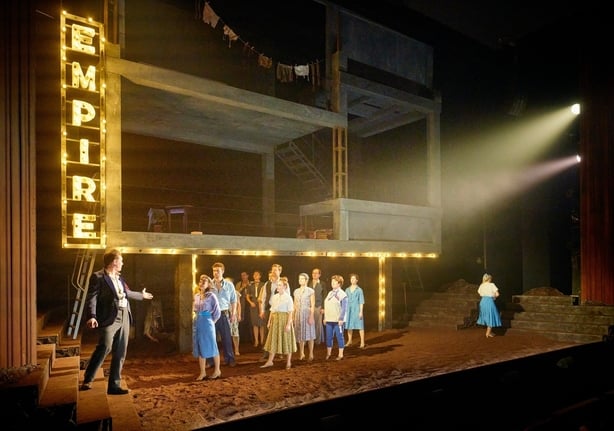
Where Bertolt Brecht once used a similar device of character alienation or "Verfremdungseffekt" in an attempt to prevent the audience from becoming too emotionally invested and to retain the ability to think critically about the play, in Dublin Gothic it is evidence of the struggle to find the correct form for the material and of its previous iterations as a television script and/or radio play. Bergin’s clear talents as a writer become submerged in its wrestling into this form and the Brutalist architecture of Jamie Vartan’s four storey set, while arresting in height and affording a diversity of movement, offers little buoyancy. This comes instead in the accomplished costume design by Madeline Boyd, which in the 19th century era of the house seems to draw inspiration from Vermeer. Figures with faces hauntingly shrouded in muslin headdresses offer arresting images and the only secure reference to the Gothic of the title while in the 1950s era of the house, the iridescent mini dresses of the dancers at the Empire Theatre (a homage to the Theatre Royal) offer sustenance through the epic.
Dublin Gothic is by no means standard Christmas fare but at the same time seeks to entertain. The realisation of a production of this scale is commendable and something that should be feasible more often in our National Theatre. While Bergin's play does not necessarily offer new angles on this fair city nor does it speak directly to its housing crisis, it does reassert the importance of place to the Irish psyche and offers a pertinent reminder that ‘the city itself was not a building, nor a bar nor an argument of houses. It was its people, those who went before, all who walked there now and those yet to come’.
Three and a half hours is a short time and an eternity in Dublin Gothic but like the city itself, rather than a fine art, it is a rollicking romp.
Dublin Gothic is at the Abbey Theatre, Dublin until January 31st 2026 - find out more here.
