


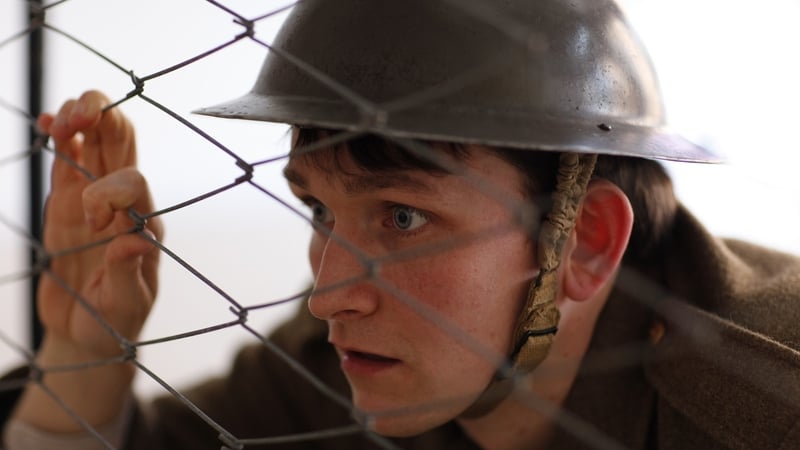
Simon Reade, the adaptor and director of the play Private Peaceful talks to RTE Culture about adapting writer Michael Morpurgo’s acclaimed book for the stage.
Michael Morpurgo published his First World War story, Private Peaceful, in 2003. I came to adapt it for stage almost immediately, in spring 2004, and have frequently returned to it: in theatre; as a radio play; as a feature film, directed by Pat O’Connor and starring Jack O’Connell. Rehearsing it now in Dublin for this new production with the young live-wire actor Shane O’Regan, has reminded me just how urgent and political and thrilling a story it is – with the extra frisson of it playing in a country with mixed feelings about a century-ago participation in a Colonialists’ war on the Continent and far away in the Middle East. My walk to rehearsals each day - from Christchurch Cathedral, along the Liffey and down to Foley Street - has brought home to me, an Englishman, the history and revolutionary anger and excitement of what erupted here 100 years ago. Something similar must have been felt in Russia at the time, too. Daring to hope for radical justice is also Private Peaceful’s theme.
Morpurgo’s story starts in the tiny Devon village of Iddesleigh, not unlike many rural communities woven into the rural fabric of Ireland, I imagine. It ends on the killing fields of Flanders, and we’ve all been there, as nations, as peoples. It’s the universality of the human experience – of growing up, of unrequited love, of dying for a cause that’s been shot to pieces by the establishment - that the play enacts. For all people. For all ages.
Private Peaceful speaks directly to the experiences of anybody who has gone from childhood, through adolescence and into young adulthood. All of us. And it speaks loudest to young people who are in the midst of that. In the First World War, young people were the cannon fodder, dying for a cause that they really didn’t understand; and if they did, they may well have deplored once they had endured the fighting. That resonates with now as we retell the story in the context of Iraq, Afghanistan, Syria, where teenagers are dying for the political ends of America, of Britain and the rest of the European Allies, of Assad, of Daesh.
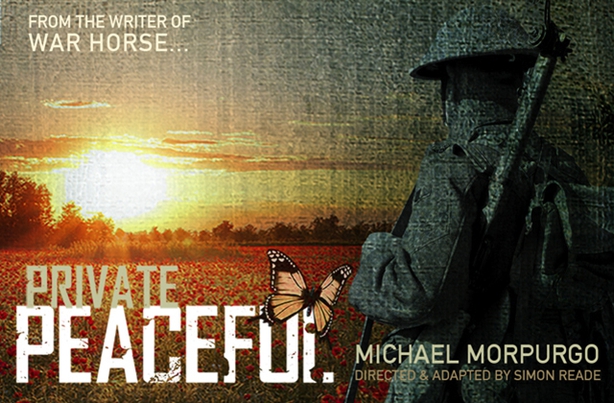
The way I have directed the play and responded to Shane’s energy and creative flare, is to embrace the kind of play-acting that you can imagine a child enjoying in their own bedroom: tipping their bed over and saying "this is a trench", or being in a field one moment and then in the middle of a market square the next, simply by articulating it. For adults watching it, it reawakens our childlike imagination, it has a young spirit about it, you get transported on extraordinary journeys with very few tricks, collectively bearing witness as an audience.
Morpurgo threw down the gauntlet when the book was published in 2003 by saying that it is surely a mark of a civilized people to admit its wrongdoings of the past: to apologise for murdering its own soldiers who were shot at dawn in the First World War for insubordination, even when they were known to be suffering from shell-shock (Post-Traumatic Stress Disorder). When we came to produce the play for the first time in 2004, that challenge had yet to be picked up, which made me conclude that so-called Great Britain wasn’t really a cradle of civilization after all. It took a few more years to civilize Great Britain and for the posthumous pardons to be granted.
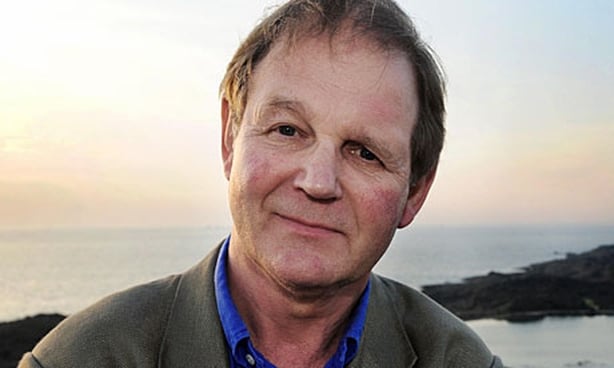
I’m not saying Morpurgo’s book, or our play, was single-handedly responsible for the change of heart, for the remorse, for the atonement of the state. But I’m glad we kept banging on about it and didn’t retreat when we were told to be ‘pragmatic’, ‘be realistic’ or not judge the past by the values of today. Too often we’re told by our peers, let alone the powers that be, that it’s not worth upsetting the apple cart. But it is. The plaques and public memorials commemorating the brave women and men of the Easter Rising on my daily walk across Dublin have reminded me of that. And if theatre can be part of a process for radical change, a social revolution for idealistic young people to tip those carts over, then we can all scrump those apples for the greater good …
Although, perhaps I shouldn’t over-extend the metaphor. Or sound off about politics. I’m a theatre-maker, a dramatist. Let the play speak for itself.
Private Peaceful makes its Irish stage premiere at Pavilion Theatre, Dun Laoghaire from May 9 and tours to Everyman Theatre, Cork (May 15 – 18), Garter Lane, Waterford (May 19 & 20), Civic Theatre, Tallaght, Dublin (May 22 – 27), Town Hall Theatre, Galway (May 29), Glór Arts Centre, Ennis, Co, Clare (May 31), Visual Arts Centre, Carlow (June 1) and Riverbank Arts Centre, Newbridge, Co Kildare (June 2) – further info on the tour here.
