


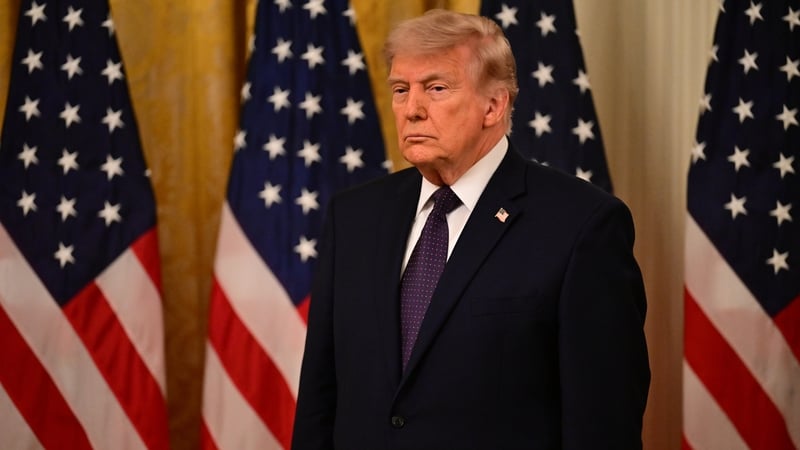
A "largely negotiated" memorandum of understanding on an Iran peace deal would reopen the Strait of Hormuz, US President Donald Trump has said although the Iranian Fars news agency disputed that claim.
Mr Trump posted on social media that the emerging agreement would reopen the strait, the vital shipping passage whose closure has upended global energy markets since the US and Israel launched the war on Iran in February.
He did not say what else would be included in an agreement.
"Final aspects and details of the Deal are currently being discussed, and will be announced shortly," Mr Trump wrote on Truth Social.
But Fars reported that the agreement would allow Iran to manage the strait and that Mr Trump's assertion on the strait was "inconsistent with reality".
Iran's nuclear program in focus
The deal includes an "apparent commitment" by Iran to give up its highly enriched uranium, the New York Times reported, citing two unidentified US officials.
Details of how Iran would cede that stockpile would be left for a subsequent round of talks, the newspaper quoted the officials as saying.
While offering various war aims during the three-month-old conflict, Mr Trump has repeatedly said the US struck Iran to prevent it from obtaining nuclear weapons.
Iran has denied it is pursuing nuclear weapons and says it has a right to enrich uranium for civilian purposes.
Iran said yesterday that it was working toward a memorandum of understanding on ending the war after its top officials met with Asim Munir, the army chief of Pakistan, which has sought to be a mediator in the war.
The Pakistani army said the negotiations had resulted in "encouraging" progress.
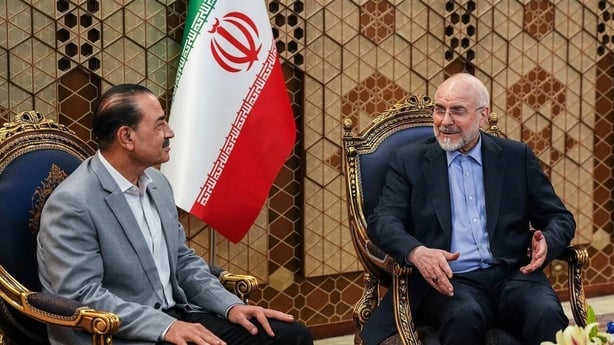
Two Pakistani sources involved in the talks said the deal being negotiated is "fairly comprehensive to terminate the war."
Pakistani Prime Minister Shehbaz Sharif praised Mr Trump on X for his "extraordinary efforts to pursue peace."
Sources have told Reuters the proposed framework would unfold in three stages: formally ending the war, resolving the crisis in the Strait of Hormuz and launching a 30-day window for negotiations on a broader agreement, which can be extended.
One of the Pakistani sources said that if the US accepts the memorandum, further talks could take place after the Eid holiday ends on Friday.
The US president, whose approval ratings have been hit by the war's impact on US energy prices, said on Friday he would not attend his son's wedding this weekend, citing Iran among the reasons he planned to stay in Washington.
'Issues still need to be discussed,' Iran says
Mr Trump spoke yesterday with leaders from Saudi Arabia, Qatar, the United Arab Emirates, Jordan, Egypt, Turkey and Pakistan.
The leaders encouraged him to agree to the emerging framework, Axios reported.
A call with Israeli Prime Minister Benjamin Netanyahu also went "very well," Mr Trump wrote on Truth Social.
Pakistan has aimed to narrow differences between Iran and the US after weeks of war have left the vital Hormuz waterway closed to most shipping despite a nervous ceasefire.
"The trend this week has been towards a reduction in disputes, but there are still issues that need to be discussed through mediators. We will have to wait and see where the situation ends in the next three or four days," said Iranian Foreign Ministry spokesperson Esmail Baghaei.
Iran has demanded supervision of the strait, an end to the US blockade on its ports and the lifting of sanctions on Iranian oil sales.
Mr Baghaei said the issue of the US blockade on Iran's shipping was important, but that its priority was ending the threat of new US attacks and the ongoing conflict in Lebanon, where Iran-allied Hezbollah militants are fighting Israeli troops who have moved into the south.
Pakistan's army chief Munir left Tehran yesterday after talks with Iran's top negotiator Mohammad Baqer Qalibaf and Foreign Minister Abbas Araqchi.
Mr Qalibaf said Iran's armed forces had rebuilt their capabilities during the ceasefire and that, if the US "foolishly restarts the war," the consequences would be "more forceful and bitter" than at the start of the conflict.
Despite weeks of conflict, Iran has preserved its stockpile of near-weapons-grade enriched uranium as well as missile, drone and proxy capabilities.
We need your consent to load this rte-player contentWe use rte-player to manage extra content that can set cookies on your device and collect data about your activity. Please review their details and accept them to load the content.Manage Preferences
Israel hits Lebanon as Hezbollah says Iran won't abandon group
Israel has struck south Lebanon despite a ceasefire as Hezbollah said its backer Tehran had pledged not to abandon the militant group.
Hezbollah said its chief Naim Qassem had received a message from Iran's Foreign Minister Abbas Araghchi, saying the latest proposal through Pakistani mediators aimed at ending the regional war emphasised "the demand to include Lebanon" in the broader ceasefire.
Lebanese authorities, however, have insisted the country's ongoing talks with Israel under US auspices must be independent from the Iran-US negotiations.
Israel's military has been pounding Lebanon despite an 17 April ceasefire in the country announced by US President Donald Trump, and which was recently extended for several weeks.
Hezbollah has also kept up attacks on Israeli targets in south Lebanon and in northern Israel, including targeting Israeli air defence platforms across the border.
The group said Mr Araghchi's message indicated Iran "will not give up its support" for Hezbollah.
Lebanon's state-run National News Agency (NNA) reported Israeli airstrikes on multiple south Lebanon locations, some after Israel issued evacuation warnings to around 15 villages.
Lebanon's military said one strike targeted an army barracks in the city of Nabatieh, wounding a soldier.
A statement from Israel's military said it "solely operates against the Hezbollah terrorist organisation and not against the Lebanese army", adding that the incident was under review.
Sanctions
Lebanon's military stressed this week that its soldiers were loyal to the institution after Washington announced sanctions that included an officer accused of sharing information with Hezbollah.
The sanctions came after the United States hosted three rounds of landmark direct talks between Lebanon and Israel aimed at ending the latest conflict.
Hezbollah drew Lebanon into the Middle East war on 2 March with rocket fire at Israel in retaliation for the killing of Iran's supreme leader in US-Israeli strikes.
Security talks with Israel are scheduled at the Pentagon for 29 May, while a fourth round of negotiations is planned for June.
Hezbollah has vehemently rejected the direct talks.
Lebanon's health ministry said Israeli attacks had killed 3,123 people since 2 March, decrying an overnight strike that damaged a hospital in the southern city of Tyre as "further proof of the Israeli enemy's violation of humanitarian law".
Israel had issued overnight evacuation warnings for two sites in Tyre.
