

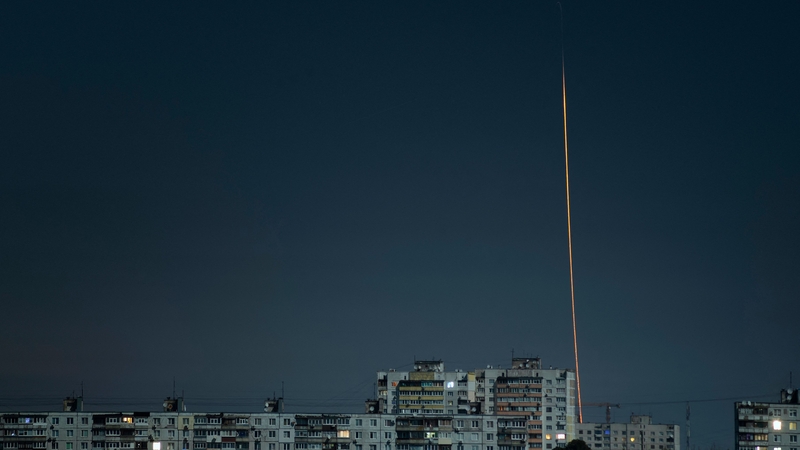
Russia launched five missiles and 12 kamikaze drones at Ukraine in an overnight attack, Ukraine's air force said early today, with officials reporting further artillery and air strikes.
The air force said the missiles, of which it shot down two, targeted northern and eastern regions, while the drones, of which 11 were downed, were launched in several directions with a particular focus on western Ukraine.
The governor of the eastern region of Poltava, Filip Pronin, said the region had been attacked by drones and missiles, and that three civilians had been hospitalised as a result.
"Fortunately, no civilian or critical infrastructure was hit.
"However, missile fragments damaged several private homes," he wrote on the Telegram messaging service.
Russia also carried out artillery shelling and air strikes in the Zaporizhzhia region, damaging several residential buildings and infrastructure and injuring one elderly woman, the governor there said.
Ukraine called for Russia to be excluded from the Organization for Security and Co-operation in Europe (OSCE), saying it faced "slow death" if Moscow remained a member.
"The situation in the OSCE is very complicated, painful, but the choice is very simple - either a slow death with Russia, or a new life without it," Ukrainian Foreign Minister Dmytro Kuleba said.
The OSCE was founded in 1975 during the Cold War to foster relations between the Western and Eastern blocs.
Russia has itself repeatedly accused the West of trying to undermine and "seize" the OSCE, arguing the group has turned away from its founding principles.
Since the start of the war in Ukraine, it has struggled to operate as Russia has blocked all major decisions, which require consensus.
Treaty shift doesn't mean Russia plans nuclear test - foreign ministry official
Russia's planned withdrawal of its ratification of the global treaty banning nuclear tests does not mean that it intends to conduct such a test, a senior foreign ministry official told Russian media.
Russia ratified the Comprehensive Test Ban Treaty (CTBT) in 2000 but the lower house of parliament, the State Duma, is due to vote tomorrow on a bill to reverse that step.
The Duma is acting on a cue from President Vladimir Putin, who said earlier this month that Russia's position on the treaty should "mirror" that of the United States. Washington has signed but never ratified the treaty.
TASS news agency quoted Vladimir Yermakov, head of the foreign ministry's non-proliferation and arms control department, as saying: "Withdrawing ratification by no means undermines our constructive approach to the CTBT and does not mean that our country intends to resume nuclear tests."
Mr Yermakov said Russia would stick to a testing moratorium it declared in 1992.
He said Russia's position was set out by Mr Putin in February when he said that Russia would only conduct a test if the United States did so first.
No country except North Korea has conducted a test involving a nuclear explosion this century.
Against the background of the Ukraine war, security analysts say a resumption of testing now would aggravate tensions still further.
Mr Putin said earlier this month he was not ready to say whether a nuclear test was needed or not.
Russian Foreign Minister Sergei Lavrov will visit North Korea this week, Moscow's foreign ministry said, as ties between the two countries solidify.
The invitation comes after North Korean leader Kim Jong Un visited Russia last month.
Moscow is believed to be interested in buying North Korean ammunition to continue fighting in Ukraine, while Pyongyang wants Russia's help to develop its internationally condemned missile programme.
"From 18-19 October, at the invitation of the (North Korean) foreign ministry, Russian foreign minister Sergei Lavrov will pay an official visit to the Democratic People's Republic of Korea," the ministry said.
Mr Lavrov is currently in Beijing ahead of an expected visit to China by the Russian leader, who has turned to Beijing for trade and support in the face of growing isolation from the West.
