

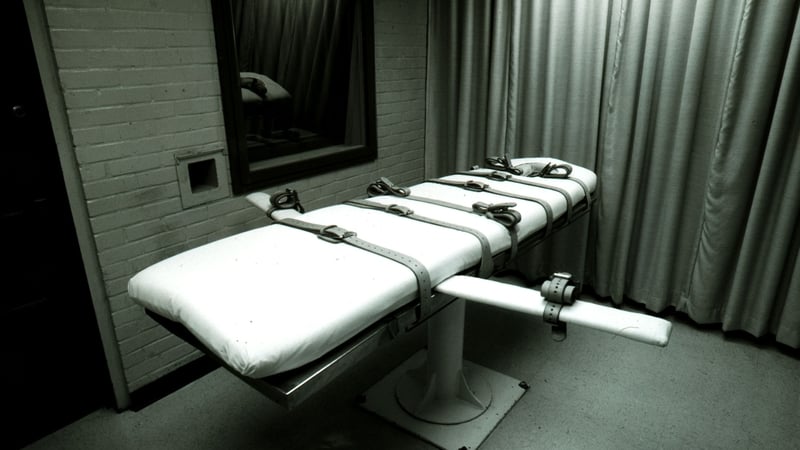
A court in Texas has delayed the execution of Melissa Lucio, a mother of 14, who was due to be put to death on 27 April for the 2007 murder of her two-year-old daughter after a controversial trial.
Pregnant with twins at the time, Ms Lucio was immediately suspected by police after her daughter Mariah's body was found at the family home covered in bruises.
Ms Lucio, 53, claims a confession was coerced by police during a five-hour interrogation and that the toddler's death was actually caused by an accidental fall down a staircase.
"This is a first step to obtaining a new trial, but a new trial has not been granted," Ms Lucio's lawyer Vanessa Potkin said during a press conference, explaining that despite the ruling, Ms Lucio is currently still on death row.
Her case has been championed by the Innocence Project, which fights for the wrongly convicted, and reality TV star Kim Kardashian, who has urged Texas Governor Greg Abbott to grant clemency for Ms Lucio.
Best news ever! 🙏🏼 Melissa Lucio has been on death row for over 14 years for her daughter's death that was a tragic accident. She is getting a hearing on her claims for her case & has been granted a stay of execution by the Texas Court of Criminal Appeals. https://t.co/NuCv4vOgJl
— Kim Kardashian (@KimKardashian) April 26, 2022
"The Texas Court of Criminal Appeals has just issued a Stay of Execution for Melissa Lucio" and ordered a lower court to consider new evidence, her lawyers said in a statement.
"She was sobbing and was beyond words," Ms Potkin said of Ms Lucio's reaction to the news.
Just received word the Texas Court of Criminal Appeals has granted a stay of #MelissaLucio's execution - remanding vital issues back to the trial court and securing justice for Melissa and for Mariah and the entire Lucio family. Praise God! #txlege pic.twitter.com/lzfWaEe7TH
— Jeff Leach (@leachfortexas) April 25, 2022
Ms Lucio, who was due to be executed by lethal injection, said: "I am grateful the court has given me the chance to live and prove my innocence. Mariah is in my heart today and always."
Mariah had a physical disability which made her unsteady while walking, according to Ms Lucio's defence, and which could have explained her fall.
The defence also argued that the bruises could have been caused by a blood circulation disorder.
"Melissa is entitled to a new, fair trial," Ms Lucio's lawyer Tivon Schardl said in a statement.
"We're waiting for Melissa to come home," Lucio's sister Sonya Valencia said.
None of Ms Lucio's children had accused her of being violent.
Her life marred by both physical and sexual assault, drug addiction and financial insecurity, Ms Lucio was immediately suspected by police and questioned at length just hours after Mariah's death.
After saying "that she hadn't done it nearly a hundred times," in the early hours of the following morning, Ms Lucio made a "completely extorted" confession, according to Sabrina Van Tassel, director of the hit documentary "The State of Texas vs. Melissa," which came out in 2020.
The documentary sparked widespread interest in the case, causing a movement to coalesce around Ms Lucio.
Along with tweets to her legions of followers from Ms Kardashian, Ms Lucio also won support from some 80 Texas lawmakers, including Republicans - traditionally defenders of capital punishment - who demanded authorities call off the execution.
"Best news ever!!!" Ms Kardashian tweeted yesterday afternoon.
Ms Lucio would have been the first Hispanic woman to be sentenced to death in Texas - the US state that has executed the most people in the 21st century and the most women, putting six to death.
It is rare for women to be executed in the United States, with only 17 put to death since 1976, when the Supreme Court reinstated capital punishment, according to the Death Penalty Information Centre.
