

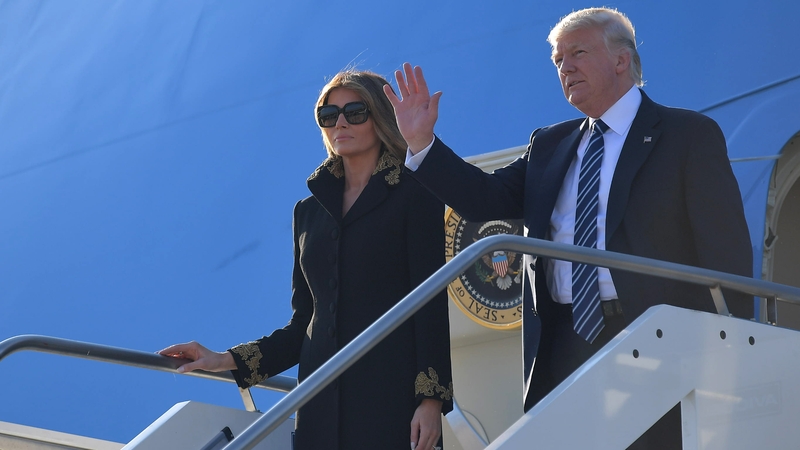
US President Donald Trump has arrived in Italy on a flight from Israel, ahead of a scheduled meeting at the Vatican tomorrow with Pope Francis and talks with Italian leaders.
Air Force One landed at Rome's Leonardo da Vinci airport, live television footage showed.
He is due to spend less than 24 hours in Italy before flying to Brussels for talks with European Union and NATO chiefs.
He will return to Italy on Thursday for a summit of major industrialised nations.
Earlier, Mr Trump used his centrepiece Holy Land speech to reaffirm his commitment to peace between Israelis and Palestinians, but he offered no new details on how to achieve a goal that has eluded US leaders for decades.
Rounding out a 28-hour stay in Jerusalem, Mr Trump praised Israeli Prime Minister Benjamin Netanyahu and Palestinian President Mahmoud Abbas alike, saying both were ready for peace.
But he avoided any mention of a Palestinian state and did not address a campaign promise to move the US Embassy from TelAviv to Jerusalem, something Mr Netanyahu yearns for.
"I had a meeting this morning with President Abbas and can tell you that the Palestinians are ready to reach for peace," Mr Trump said in a speech at the Israel Museum in Jerusalem.
"In my meeting with my very good friend Benjamin, I can tell you also that he is reaching for peace. He wants peace," he said.
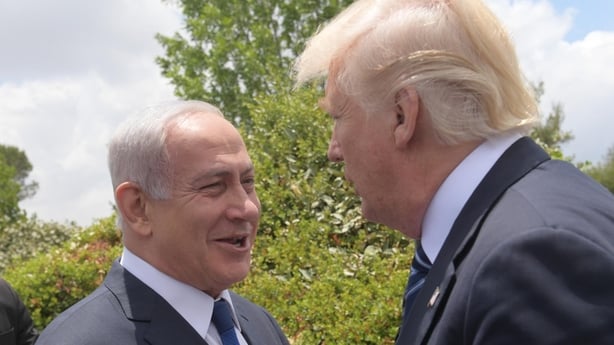
"Making peace, however, will not be easy. We all know that. Both sides will face tough decisions. But with determination, compromise, and the belief that peace is possible, Israelis and Palestinians can make a deal."
While Mr Trump has spoken frequently in the months since taking office of his desire to achieve what he has dubbed the "ultimate deal", he has not fleshed out any strategy that he or his administration might have towards achieving it.
He also faces mounting difficulties at home, where he is struggling to contain a scandal after firing James Comey as FBI director two weeks ago, and a widening investigation into his administration's connections to Russia.
Mr Trump has appointed his son-in-law, Jared Kushner, as a senior adviser on brokering an Israel-Palestinian deal, while Jason Greenblatt, formerly a lawyer in his real estate group, has taken the day-to-day role of liaising with leaders and officials in the region on the nitty-gritty of a solution.
The last talks between the Israelis and Palestinians, led by former US secretary of state John Kerry, broke down in April 2014 after around a year of largely fruitless discussion.
While both Mr Netanyahu and Mr Abbas reiterated during Mr Trump's visit a commitment to peace, both also face domestic constraints on their ability to manoeuvre or compromise.
Mr Netanyahu must deal with opposition from right-wing nationalist elements within his coalition who oppose any Palestinian state being created in occupied territory where hundreds of thousands of Jewish settlers now live.
For its part, Mr Abbas's Fatah party is at sharp odds with the Islamist group Hamas, which is in power in Gaza, leaving no unified Palestinian position on peace.
