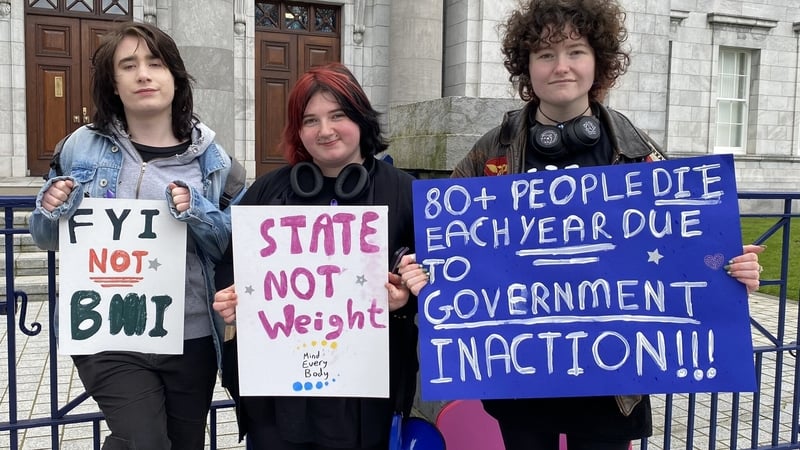

Protests are taking place at three cities across the country today demanding urgent reform of the eating disorder services available to those who need help.
Organised by MindEverybody, parents and campaigners are gathering in Cork, Limerick, and Dublin calling on the Government to urgently address the inadequate services available to individuals and their families.
Campaigner Amy Hanley, whose daughter was diagnosed with anorexia in 2022, said: "No family or individual should ensure the obstacles we faced in securing treatment for my daughter.
"It's time to dismantle the multiple barriers that impede access to care for eating disorders in this country.
"If the authorities treated this mental health condition with the gravity it deserves, not only could it alleviate the profound suffering experienced by patients, but it could also significantly reduce the economic burdens," she said.
These include the costs of multiple hospitalisations, treatment in private facilities here or abroad, and the financial pressures on caregivers without sufficient State supports.
The Health Research Board reported in 2023 that the number of child and adolescent admissions for eating disorders has more than doubled in the last five years, from 33 in 2018 to 80 in 2022.
According to the Health Service Executive, eating disorders have the highest mortality and morbidity within mental health and they pose significant health, social and economic costs to people with eating disorders, to their families and to society.
Just three beds dedicated to adults with eating disorders are provided in the State's public hospital system, but services are being delivered through other avenues, an Oireachtas sub-committee on mental health was told in 2022.
The HSE estimates that up to 180,000 people in Ireland are affected by eating disorders, with up to 1,800 new cases occurring each year.
Last November, the Department of Health said it is "firmly committed" to enhancing specialist services for eating disorders, including improved access and shorter waiting lists.
Ended up 'aging-out' of the CAMHS
Among the protesters in Cork were Luna Fleming and Meave O'Sullivan. Luna, who is 19, said she struggled with an eating disorder since she was 12 years old.
"I was on a waiting list for services and ended up 'aging-out' of the CAMHS (Child & Adolescent Mental Health Services) and unfortunately in Cork, there are no specific eating disorder services publicly, so I never received services."
"We are looking for counselling for people with EDs in every region, more in-patient beds as there are only three currently in the country, more education for carers and more accurate statistics on how many people have EDs in the country," she told RTÉ News.
Meave O'Sullivan said she has had similar struggles like Luna.
"I've been lucky to attend the only public service which is in Dublin but it is the only one of its kind and while there are others being set up, it is just too slow. We need more happening."
Over €8 million in funding
In response to today's calls for urgent action, the Department of Health said the Government remains "firmly committed to enhancing specialist services for eating disorders, including improved access and shorter waiting lists".
In a statement, it said the HSE has prioritised eating disorder services as part of its National Clinical Programme with over €8 million allocated to these services in recent years .
They have also hired 100 Whole Time Equivalents (WTE) within the Eating Disorder services, although the recruitment of dietitians remains a challenge, they said.
Funding has also enabled the establishment of 11 of the 16 teams promised under the HSE's National Eating Disorders Model of Care in 2018.
There are 6 adult and 5 CAMHS eating disorder teams at various stages of development around the country.
The Department of Health said the majority of young people referred to the CAMHS eating disorder teams are treated in the community, and in-patient care is provided in all 4 regional CAMHS units nationwide.