

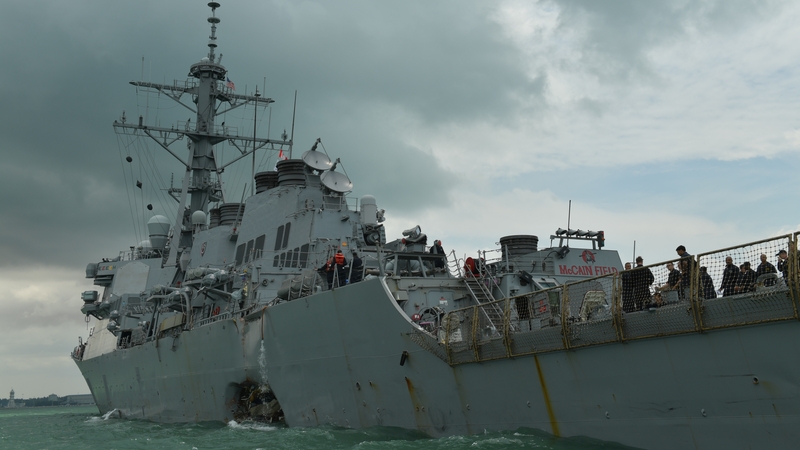
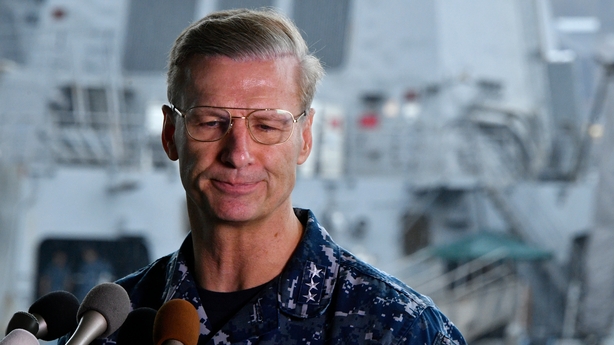
The US Navy has removed Seventh Fleet Commander Vice Admiral Joseph Aucoin after a series of collisions involving its warships in Asia.
Commander Aucoin's removal comes days after the fourth major incident in the US Pacific Fleet this year.
A search continues for ten sailors missing since Monday's pre-dawn collision between a guided-missile destroyer, the USS John S McCain, and a merchant vessel east of Singapore and Malaysia.
"Admiral Scott Swift, commander of US Pacific Fleet, today relieved the commander of Seventh Fleet, Vice Admiral Joseph Aucoin, due to a loss of confidence in his ability to command," the US Navy said in a press release.
.@US7thFleet Commander Vice Adm. Joseph Aucoin relieved due to loss of confidence - https://t.co/nKje5HcNeU via @USPacificFleet pic.twitter.com/jMevhupdFZ
— U.S. Navy (@USNavy) August 23, 2017
An international search-and-rescue operation involving aircraft, divers and vessels from the US, Singapore, Malaysia, Indonesia, and Australia is looking for the missing sailors.
Yesterday, US Navy and Marine divers found human remains inside sealed sections of the damaged hull of the USS John S McCain, which is moored at Singapore's Changi Naval Base.
The US Navy has not yet announced the identities of the bodies discovered.
It is also working to identify a body found by the Malaysian navy about eight nautical miles northwest of the collision site.
The latest collision has already prompted a fleet-wide investigation and plans for temporary halts in US Navy operations.
The John S McCain's sister ship, the USS Fitzgerald, almost sank off the coast of Japan after colliding with a Philippine container ship on 17 June.
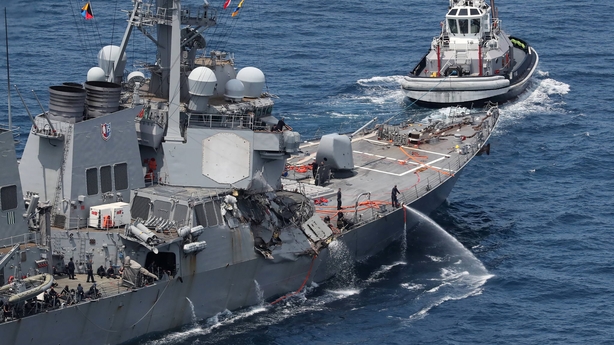
The bodies of seven US sailors were found in a flooded berthing area after that collision.
The incident involving the USS John S McCain and the tanker Alnic MC in the Singapore Strait came at a tense time for the US Navy in Asia.
This month, the John S McCain sailed within 12 nautical miles of an artificial island built by China in the disputed South China Sea, the latest "freedom of navigation" operation to counter what the US sees as China's efforts to control the contested waters.
An official Chinese newspaper said yesterday the US Navy's latest collision shows it is becoming an increasing risk to shipping in Asia despite its claims of helping to protect freedom of navigation.
Also this month, North Korea threatened to fire ballistic missiles towards the US Pacific territory of Guam in a standoff over its nuclear and missile programmes.
The Seventh Fleet, headquartered in Japan, operates as many as 70 ships, including the US Navy's only forward-deployed aircraft carrier, and has around 140 aircraft and 20,000 sailors.
It operates over an area of 124 million square kilometres from bases in Japan, South Korea and Singapore.
Admiral Swift, who travelled to Japan to relieve Commander Aucoin, ordered his deputy Pacific Fleet commander, Rear Admiral Phil Sawyer, to immediately take command of the powerful US force.
Commander Aucoin was due to step down next month, with Rear Admiral Sawyer, deputy commander of the Pacific Fleet, a submariner, already slated to succeed him.
