


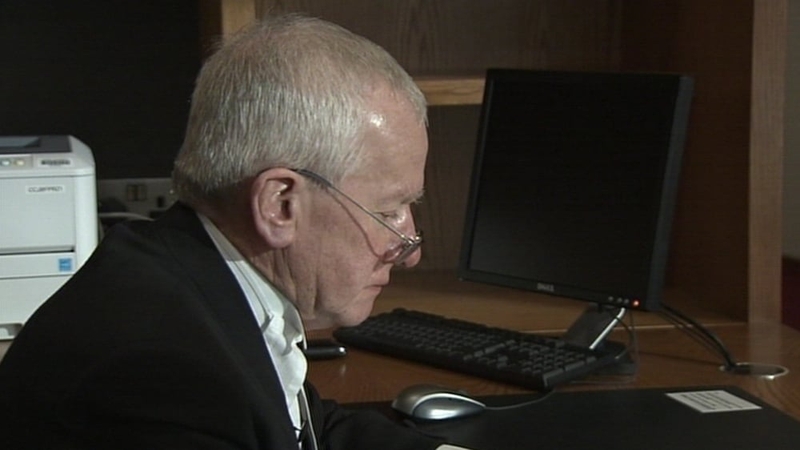
The High Court has ruled that the Minister for Justice's refusal to put retired judge Barry White on the criminal legal aid panel breached his right to earn a livelihood.
The court has found the "tradition" of retired judges not practising in courts lower than those they presided over is not a rule of law.
Mr Justice Max Barrett said "antediluvian pretensions of judicial superiority" have "no place in our modern republic of equals".
The Court ruled that the Bar Council did not err in law regarding Mr White's bid to resume practise but the Minister for Justice did.
The Court ruled a retired judge can return to practise as a barrister in circuit and higher courts.
However, the judge declined to declare unconstitutional a rule of the Bar Council's code of conduct, which prevented him from returning to practise, because he said the Bar is effectively a private club that is entitled to operate its own rules.
He also declined to award him damages or to find there had been a breach of his European Convention rights.
Barry White, 71, who retired in 2014 after 12 years as a a judge, claimed the Bar Council rule, and the application of that rule by the Minister for Justice so as to exclude him from the criminal legal aid panel breached his constitutional rights to work and earn a livelihood.
As part of his action, Mr White, a father of four, claimed he needs to resume work out of economic necessity and his existing income is not adequate to his family's needs.
He had also suffered cuts of some 38% in his pension entitlements.
The Bar Council and Minister denied any breach of rights and said he had not shown he needed to return out of economic necessity.
It was argued Mr White had had a successful criminal practise before earning between €145,000-€240,000 annually over 12 years as a judge.
He also got a €250,000 lump sum on retirement, had a €78,000 annual pension and previously inherited an estimated €1m plus from his late mother's estate, the Bar Council argued.
His wife is also working.
The disputed rule prevented a judge resuming practise in a court equal to, or lower than, where he presided.
In Mr White's case, that prevented him practising in the criminal courts and confines him to the Court of Appeal and Supreme Courts.
In his judgment, Mr Justice Barrett said current appeal court judge and distinguished constitutional expert, Gerard Hogan, had written in an article in 1988 that there was no strict legal impediment to a judge returning to practice.
That was a convention that arose out of a 1930 Supreme Court ruling concerning a judge who also wanted to return to practise after he retired.
Mr Justice Barrett said he could not but observe that that decision, though eloquently crafted in the style of its time, "is premised on notions that strike a discordant tone in our more meritocratic and egalitarian age."
That Supreme Court judgment referred to the role of a judge as "a sacred office", Mr justice Barrett said.
"Being a judge is undoubtely a responsible job, and it is a privilege to be given the job, but ultimately it is just a job.
"The idea it is a sacred office, i.e. connected with some god or dedicated to a religious purpose, and so deserving of veneration, is with every respect to a rightly respected judge, fanciful".
