


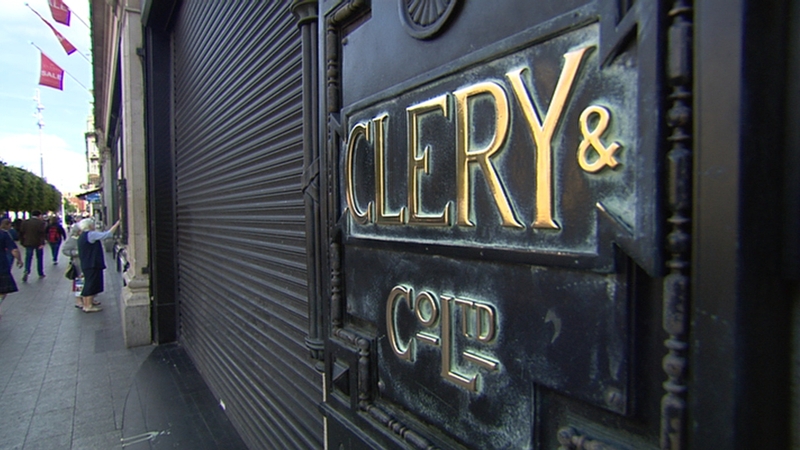
The legal and factual position of workers employed at Clerys department store are "inextricably linked" to events and transactions involving investment Company D2 Private Ltd and its owner Deidre Foley, the High Court has heard.
The claim was made by inspectors appointed by the Workplace Relations Commission following the store's closure in June 2015 shortly after its sale by its owners.
Approximately 460 people either directly employed by Clerys or by various concession holders in the store lost their jobs.
The WRC and the inspectors are opposing proceedings brought by D2 and Ms Foley challenging the powers used when they seized documents and a computer from D2's offices in May.
The inspectors say that as part of their investigation they are examining the involvement of Ms Foley and other persons and companies leading to the making of the collective redundancies.
Ms Foley, the inspectors add, collaborated in and was directly involved in events which preceded the making of the collective redundancies at Clerys.
The challenge against the WRC arises after the inspectors along with gardaí entered the D2's offices at Harcourt Terrace Dublin in May and seized various materials.
D2 Private and Ms Foley contest the inspectors reliance on provisions of the 1977 Protection of Employment Act and the 2015 Workplace Relations Act, including an entitlement to enter premises and take documents.
The inspectors were appointed by the WRC following Clery's closure in June 2015, shortly after its sale by its previous owners, the Gordon Brothers Group, to Natrium Ltd.
Natrium is a joint venture made up of D2 Private Ltd, and Cheyne Capital Management in the UK.
The documents include correspondence the company had with parties including the liquidators and directors of the company that had operated Clerys, OCS Operations, before Natrium acquired the store.
Opening the case, Eoin McCullough representing D2 and Ms Foley said his clients said the powers being asserted by the inspectors allowing them take the materials seized are unconstitutional.
The inspectors can only take documents and materials relevant to their investigation, counsel said.
Counsel said it was never the case, and it has always been accepted, that Ms Foley and D2 were never the employers of the Clerys' workers. OCS operations was at all times the workers' employer, counsel said.
Ms Foley and D2 also have a minority stake in Natrium, with some 80% of that entity being owned by Cheyne, counsel said.
The inspectors are for "public interest reasons" seeking to "look into the commercial transaction" concerning the sale of Clerys to Natrium, they added.
This in effect amounts to a "parallel investigation", which he said they are not entitled to do.
Counsel added the inspectors have decided to bring criminal charges arising out of the Clerys' workers redundancy.
The inspectors had not informed his clients as to who those charges are to be brought against and the decision to issue a summons was done before the raid took place.
Counsel for the WRC and the inspectors say the applicants have no right to complain about the scope of the investigation.
Given the information gathered by the inspectors, D2 premises had become a place of specific interest to the investigators.
The materials seized were taken in the course of the inspectors carrying out the lawful exercise of their duties.
The inspectors were entitled to enter the office without a warrant.
The inspectors also say that while they have always maintained OCS Operations Ltd were the employers for the purpose of the investigation D2 and Ms Foley have failed to consider that such a claim form part of the investigation itself.
The investigators are also endeavouring to establish who in fact made the decision to make the collective redundancies, the court also heard.
The collective redundancies resulted in the Social Protection Fund paying €2.5m to the workers, the inspectors also said.
The hearing continues.
