


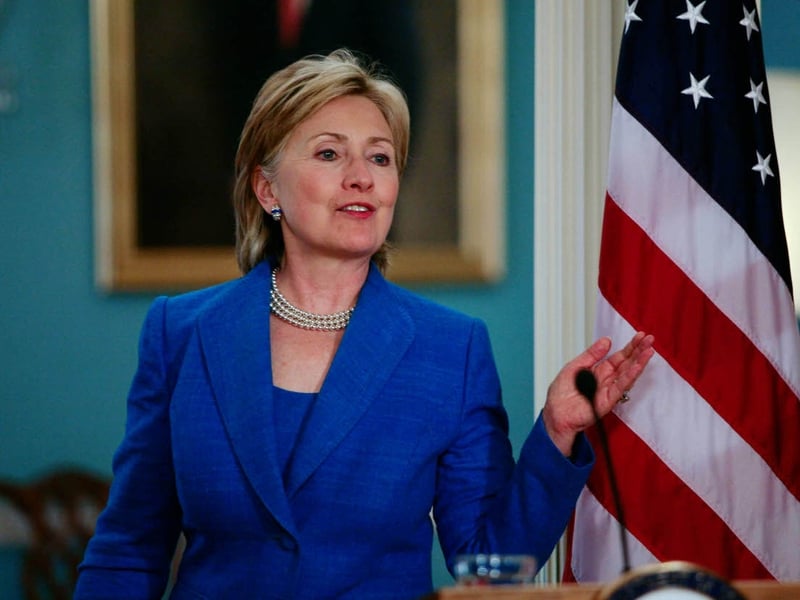
US Secretary of State Hillary Clinton has said the time has not yet come for more sanctions against Iran over its nuclear programme.
Hillary Clinton was speaking at a news conference on her first visit to Russia since taking her post.
She quoted Russian President Dmitry Medvedev as saying sanctions against Iran might be inevitable, adding: 'But we are not at that point yet.'
She said, 'we want to be very clear that it is our preference that Iran works with the international community...to fulfil its obligation on inspections'.
She also praised what she said was Russia's help in tackling the issue.
Mrs Clinton generally played down differences with Moscow at a news conference held jointly with her Russian counterpart Sergei Lavrov.
Instead she spoke of cooperation with Moscow on a range of international issues including nuclear disarmament and missile defence as part of a so-called 'reset' of relations proclaimed by US President Barack Obama.
'I feel very good about the so-called reset', she said.
State Department officials had said before the talks that Mrs Clinton would discuss with Moscow 'specific forms of pressure' on Iran if it failed to keep promises not to pursue nuclear weapons but Mrs Clinton denied she had made any requests.
'We did not ask for anything today. We reviewed the situation and where it stood, which I think was the appropriate timing for what this process entails,' she said.
Mr Lavrov restated Russia's position that talk of sanctions against Iran at this stage was counter-productive because international efforts should be focused on diplomacy.
Iran agreed at a meeting with world powers in Geneva on 1 October to allow UN experts access to a newly disclosed uranium enrichment plant near the city of Qom.
Officials called the talks constructive, but Mrs Clinton warned on Sunday the world would not wait forever for Iran to prove it was not building nuclear bombs.
Missile defence
US President Barack Obama's decision to scrap plans for an anti-missile system located in eastern Europe has helped improve ties with Moscow after stormy relations under his predecessor, George W Bush.
But diplomats say that in return the US now wants better Russian cooperation on an array of foreign policy issues such as the US-led war in Afghanistan, missile defence and a nuclear arms reduction treaty.
Mr Lavrov said 'considerable progress' had been made by US and Russian negotiators towards a new bilateral treaty cutting their stocks of strategic nuclear weapons.
Both sides are working to a deadline of December for concluding a new treaty to replace the landmark Cold War-era START pact.
On missile defence, Mr Lavrov said Russia had listened to US plans for a new anti-missile system to replace the Bush-era plan for fixed radars and anti-missile batteries in central Europe which had upset the Kremlin.
But he was non-committal on US proposals the two sides cooperate on missile defence.
'We want to know what are these plans, what they provide for, how the concept will function,' he said.
'The more we know about this concept, the sooner we will come to understanding of whether we can work jointly on a project'.
Some Russian officials, including Moscow's ambassador to NATO Dmitry Rogozin, have suggested Mr Obama's new missile defence plan involving sea-based and mobile missiles could pose an even stronger security threat to Moscow.
Russian officials say Moscow's concerns would only be addressed if it became an equal partner in any European anti-missile system.
