




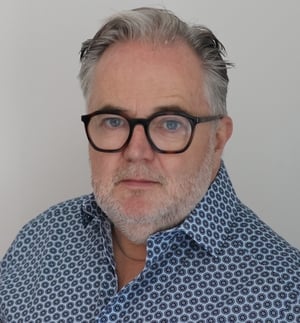
John McMahon, now a Commissioning Executive Producer with RTÉ Television, shares his reminiscence of the day RTE.ie went live thirty years ago.
The year was 1996.
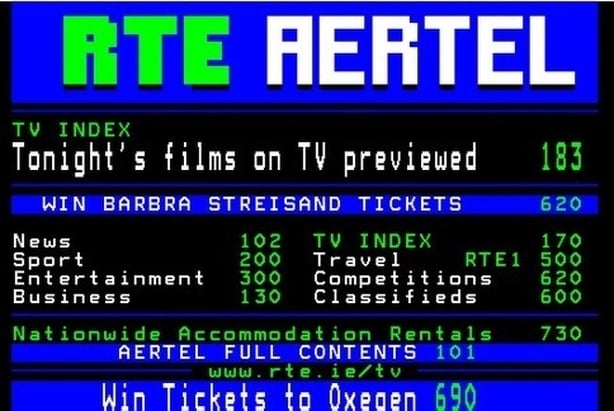
The Spice Girls and Boyzone released their debut singles. Meath and Wexford were All‑Ireland champions and Eimear Quinn won the seventh (and, to date, last) Eurovision for Ireland. Veronica Guerin, Canary Wharf and Michelle Smith dominated the headlines. Across the water. football was Coming Home.And anyone who wanted to read about any of that as it happened, went to Aertel, RTÉ’s teletext service.
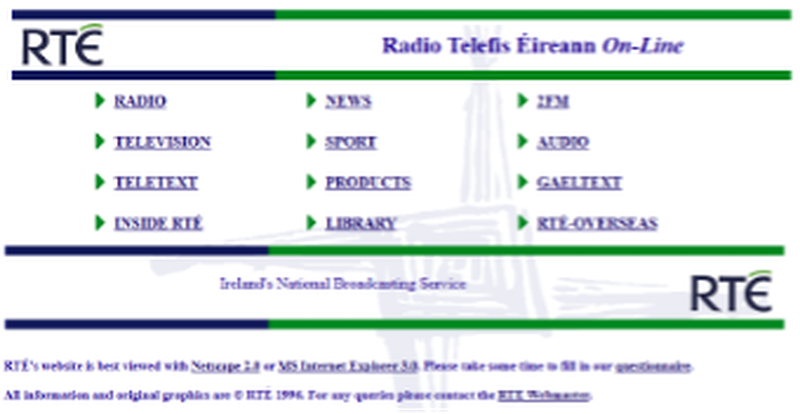
Nobody who was anybody ever went online for anything useful - and for very good reason.It’s almost impossible now to remember just how much of a frontier "the internet" was in 1996. Netscape Navigator was the browser of choice. Almost every website had a grey background, black text and blue underlined links with almost no images, and certainly no audio or video.
Aertel, meanwhile, was on every television in the country. Aficionados knew 102 was News, 200 was Sport and 310 was Cinema listings, among hundreds of other pages.I was a freelance journalist, not long out of college, working occasionally on Aertel’s news output and looking for a full‑time job. RTÉ did one of its regular hiring rounds for Aertel staff, and knowing I was probably too junior to land a permanent role, I went into the interview and told them they shouldn’t hire me as an Aertel journalist — they should hire me to build them a website!
After all, I knew how to code (I had read precisely two chapters of Teach Yourself HTML, a free book that came with .Net magazine). I had been online (for about 15 minutes, at a very expensive internet café). And I could see the future (I had watched a teenage techie wow Gerry Ryan on RTÉ television about the possibilities of the World Wide Web).Somehow, they bought it.I was hired as RTÉ’s first content webmaster — tasked with figuring out what RTÉ should be online. I got my first email address (webmaster@rte.ie), a new computer with a huge 800 × 600 screen, and a mission: get RTÉ Online launched.
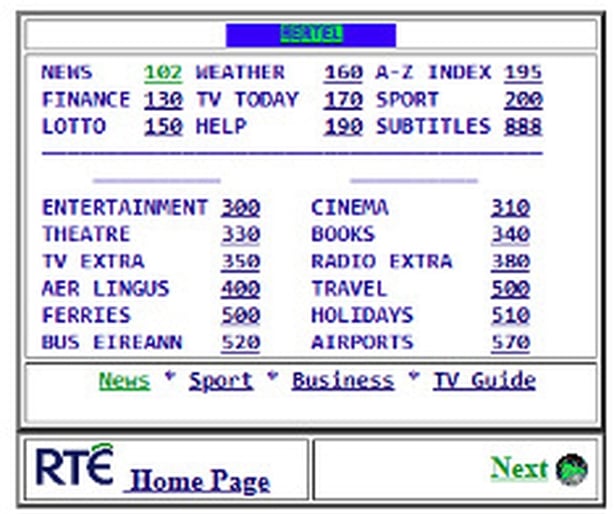
That teenage techie from the television, Declan Caulfield, was hired alongside me as the technical lead. Between us, we formed a small, unofficial two‑person start‑up inside RTÉ and were asked to put the organisation on the information superhighway (yes, people really did talk like that then!).Working with Intelfax, whose software powered Aertel, we wrote code that automatically converted teletext updates into web pages carrying the latest news. They weren’t pretty, but they were fast and always current.In a world of 28k modems and dial‑up internet, size mattered. A teletext page with little more text than a tweet and a 3k graphic wrapped in an ugly HTML table was about as small as a web page could get.
And we produced a lot of them.
We tested, we tweaked, we coded — Declan bending servers, codecs and operating systems to his will, while I tried to impose some kind of editorial structure on a medium that had none.We ate pizza and drank Jolt Cola (all the sugar, twice the caffeine) in a tiny office in the dankest corner of RTÉ. We were the weirdos working on the odd project nobody really cared about. But we were left to get on with it, and I used my (very) limited HTML skills to automate text links so that every time an Aertel page number appeared, you could click it and navigate the site.
After months of preparation, we were nearly ready. We were due to launch in May 1996 and, between us - after several big thoughts and at least one very bad idea - we decided to try something that nobody sane would attempt at the time: putting The Late Late Show live on the internet.
Not writing a web page, you understand. Broadcasting the programme. Live.
This was at a time when nobody anywhere was doing video online. YouTube was still almost a decade away and the idea of putting anything out live was just unthinkable. But we thought it. We had a handful of RealAudio clips available for download and vague plans to make programmes like Morning Ireland or Today with Pat Kenny accessible to Irish people overseas on their lightning‑fast 56k modems.But television? We had clearly had too much Jolt Cola.
Declan identified a company called Xing Technologies, whose Streamworks system used multicast technology¹ to distribute video across local networks. With a lot of adaptation, collaboration and brand‑new code², he and they attempted to stretch that technology across the open internet — something it was never really designed to do.The promise was a tiny 160 × 120 frame of moving pictures. If it worked — and if we could borrow a suitably powerful Silicon Graphics Unix server — we might, just might, pull it off.
After several phone calls and a bit of wheeling and dealing, an SGI Indy server was secured on loan³. More days followed that involved rewiring, recompiling, rewriting, praying and starting again.Getting a video feed into the machine was one thing. Getting anyone outside RTÉ to actually see it was quite another.
And yet, we had told Gay Byrne that The Late Late Show would be live around the world for its final programme of the 1996 season on 24 May — and on that basis, we were granted permission to use RTÉ’s flagship show to launch our fledgling new service, www.rte.ie.
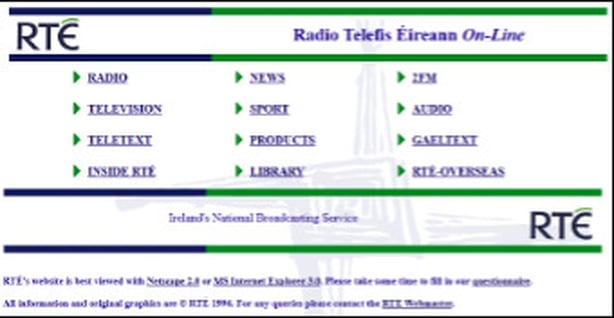
Working around the clock, more sections came live. Sport worked. TV was stable. News was solid. Entertainment and jobs were still wobbly. Anything involving finance regularly collapsed, because the automation software kept mistaking stock‑market numbers for teletext page references and enthusiastically trying to link the ISEQ index to imaginary pages. As Thursday 23 May turned into Friday 24 May, we were still hard at it.I was checking facts, reshaping frames and changing automations, while Declan rebuilt servers, re‑patched video feeds ⁴ and worked helpdesks around the globe — saying goodnight to San Francisco and hello to Hong Kong — chasing the handful of people on earth who might be able to help make live internet television work.
We also managed somehow to convince Telecom Eireann to dig up the road and deliver us a brand new fibre optic cable the day before our launch. Don’t ask! I remember slipping up onto the roof of the TV building (don’t tell the DG) at sunrise on 24 May, sharing a drink with Declan and knowing that, whatever happened, it was going to be a day we’d remember. We still had no idea if the television stunt was genius or madness.
All day Friday the rebuild continued. Permissions were tweaked. Code paths altered. Then, shortly after 8.30pm, it worked⁵. Neither of us entirely knew why — just that it finally had. At least here in RTÉ. Whether anyone on the other side of the planet would be able to log in, remained a mystery.Later that night, during part three of The Late Late Show, Gay took a phone call from a viewer called John Piggott, originally from Clonskeagh and now living in Phoenix, Arizona. He told Gay he was watching "a small fuzzy picture" of the programme live on the internet, to the astonishment of the audience and guest Brendan O’Carroll.
We need your consent to load this rte-player contentWe use rte-player to manage extra content that can set cookies on your device and collect data about your activity. Please review their details and accept them to load the content.Manage Preferences
RTE.ie goes live
To my knowledge, no other broadcaster in Europe had managed that by May 1996⁶. Even if most viewers didn’t realise the significance, Declan and I did — or would have, had exhaustion not completely overtaken us by that point. Even two years later, when I moved to RTÉ Radio as a producer, I was still regarded as the oddball who knew about the internet. My PC in Radio Centre was the first connected to the web.This was before smartphones, before Google, when Ask Jeeves and Lycos ruled — and social media meant talking about the Sunday newspaper over coffee.
Today, RTÉ.ie records more than a billion page impressions each year, most of them on mobile devices, and the RTÉ Player is central to the organisation’s strategy for reaching younger audiences.There are hundreds of talented people behind that growth, many of whom have contributed far more than I ever did.
There were also pioneers before us — people like Kate Kavanagh and Eamonn Farrell who ran that very special Aertel office and gave me "the start"… Our boss Eugene Murray who took a chance on going online when very few people knew what that meant. The RTÉ digital pioneers like Barry Lang, Dusty Rhodes and Paul Russell, who put 2fm online on www.iol.ie/~2fm before rte.ie existed; or RTÉ engineer Paul Arbuckle, who was automating radio programme downloads for overseas listeners before on‑demand audio was available anywhere!And there were Karina Carroll and her colleagues Barry Flanagan and Colm Grealy at Ireland On‑Line, who provided the country’s first commercial dial‑up internet access, and a small community of early believers who sensed something big was happening while most of the world carried on as usual.
Their madness, energy and vision helped create the first wave of the www. Before social media, before trolls and before spam bots. They deserve all the credit and very little if any of the blame! As RTÉ marks its centenary, it feels strange to think that what we helped begin became such a central part of how people now access everything the organisation makes today. It very nearly didn’t happen!
Notes
1. Xing Streamworks was originally designed for multicast delivery across local area networks. Making it work on the open internet required extensive adaptation, experimentation and cooperation with network partners worldwide.
2. In practice, this meant rewriting large sections of software, developing new live‑video workflows and repeatedly testing approaches that often failed before they briefly worked.
3. The SGI Indy was one of Silicon Graphics’ smaller Unix workstations — powerful by 1996 standards, but still well below anything normally used for live broadcast work.
4. RTÉ’s broadcast and IT infrastructure was still adapting to the implications of internet delivery, and many network paths and systems were being used in entirely new ways at the time.
5. The core streaming system was successfully rebuilt and recompiled shortly after 8.30pm, with relay partners overseas confirming receipt of the live signal later that evening, just ahead of broadcast.
6. In the mid‑1990s, fewer than 1% of the world’s population had access to the internet. Today, the figure is over 70%, with video accounting for the majority of global internet traffic.John McMahon is a Commissioning Executive Producer with RTÉ Television and has worked across RTÉ Online, Radio 1, 2fm and RTÉ Television.
