



We present an extract from The Coast of Everything, the forthcoming novel by Guillermo Stitch.
To find the center, begin at the edge . . . A daughter's devotion parts her from her father. A dutiful soldier sentences his daughter to a loveless exile and her mother to madness. With her last breath a dying woman exhales the whole world. A young girl with a broken body holds it up. Their nested stories bleed into one another, tributaries in search of a common sea.
At low tide, we would leave our shoes, with our socks in them, on the grass verge, and you would take my little hands in your own—not very much larger—and lower me down the sheer sand bank till my feet were in the water and I was brave enough to say "Now". You would let go, and I would drop those last few inches till I stood with water lapping half way to my knees, my skirt tucked into my knickers to keep it from getting wet. Then you would shoo me away into the water a little and make a great show of lowering yourself unassisted. I believe you needed me to see that. Perhaps I needed it too.
When it was time to go, you would crouch low and brace yourself with your hands against the damp bank while I climbed on to your back to stand on your shoulders. Then you would straighten up till I could reach a clump of hardy marram grass and pull myself onto the verge. You would pull yourself up behind me and, clutching at the grass with one hand, would wave mine away with the other. In the warmer months we would sit there till our feet dried and when it was cold we'd put our wet feet back into our socks and shoes and you would insist I go home directly to change them.
I called it "my cove" and you called it "your cove". We would wade about and find little crabs and wonder at the shoals of tiny fish and how they remained stock-still in the water that ebbed and eddied around them. When we first found that place, you in your boyish braggadocio would offer me a discourse on this fish or that, or an improvised treatise on the colours of a crustacean, and I was sure, even then, that the science you imparted was quite invented. When we were a little older and had accepted, the both of us, that though the younger I was nevertheless the brighter and had remembered more from Mr Fafl’s schoolbooks, you would rather listen, head bowed and gaze averted, as I told you things you did not know—and this reversal, this demotion from lecturer to listener, never seemed to bother you a bit. I think it delighted you. From that day to this, I have never observed you so at peace as when you listen to me, head bowed and gaze averted—you are the well into which I have cast all my pennies. My riches. You are the depth and I the diver. I still have not found the bottom of you.
After a time I would invariably tire of the minutiae and would leave you to wade, bent over in search of foot-level fascinations. My back would straighten, my attention turning to the cove itself, which was almost circular save for where it opened onto the sea like the gap between a crab’s claws, and it would be I who stood still while the water eddied around me, to fix my eyes upon the waterline. I would try to apply my young intellect to the unimaginable distances. I would fail, but the attempt would send a thrill through me—particularly once mother had begun to tutor me, and to pour the magic of elsewhere into me—till the waterline seemed to me the rim of a great cup, filled with world, to which I longed to put my lips.
On clear days, sunlight would glint where it bounced from the buoys to remind me the cup was a forbidden one. That I could not drink from it. But just to stand there and send my gaze shooting beyond that deadly barrier to the horizon, and thence let my imagination carry me beyond, was an escape of sorts. It was the best of times, for I could make that leap, that boundless journey, knowing that behind me, all the time, was my Simon—that you could rummage around amongst the particulars of this world, the island, and I could, at least in my fancy, escape it, and we could do these things without parting. It was our first escape, in fact, that place. We trod every inch of the Warburg, you and I, the arrangement a neat one—I would guide you and you, when called upon, would carry me. But there was nowhere to which we returned more often. You would escape to it and I from it. It was our unspoken promise to each other. Our covenant.
It was our cove.
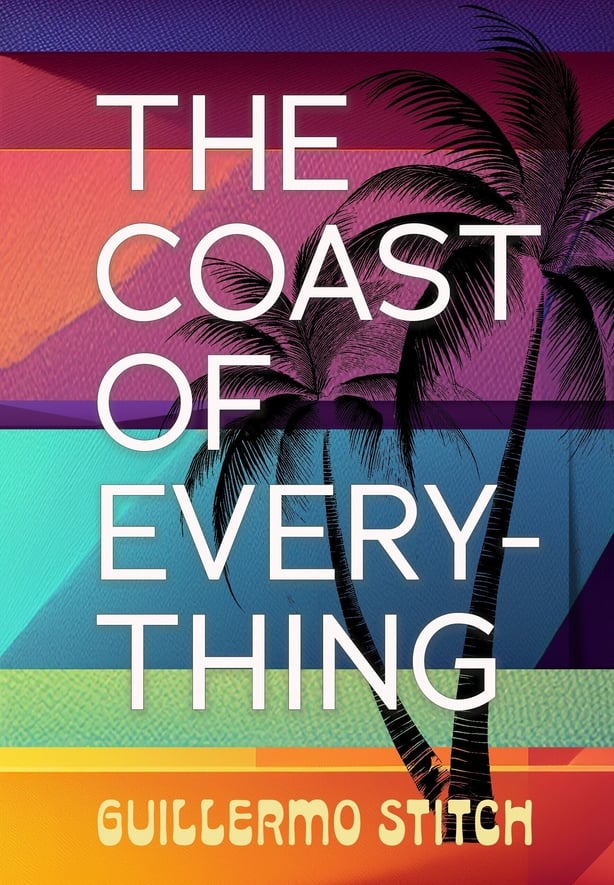
The Coast of Everything will be published on June 16th by Sagging Meniscus Press, and will be launched on Wednesday 17th of June at Hodges Figgis, Dublin; the author will be joined by June Caldwell and Joycean essayist David Collard to discuss the book.
